
Requirement clarity is handled by this skill in a customer-readable, reusable workflow.
Traceability is handled by this skill in a customer-readable, reusable workflow.
SB_srs_governor@SB_srs_governorAgent SetupIncluded in bundle10 minutes
What is this?
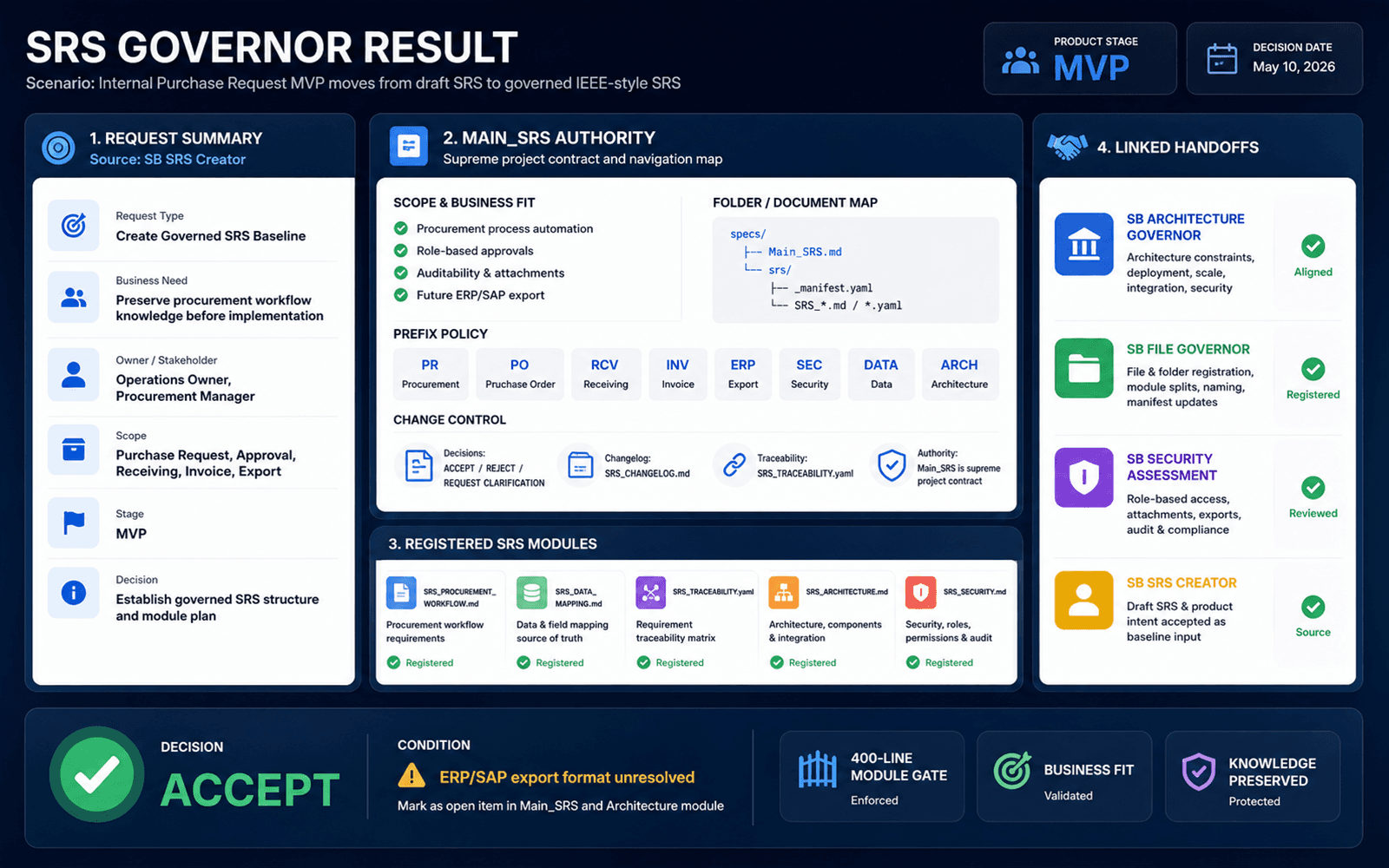
A first Software Requirements Specification (SRS) draft is not automatically a reliable build contract. Requirements can still contradict each other, lack acceptance checks, or change casually in chat. SRS Governor turns the draft into a governed requirements system: one authority file, requirement IDs, modular reading paths, traceability, acceptance discipline, and change control. Later architecture, coding, and audit work can then build from the contract instead of memory.
When this helps
What you get
- SRS review
- Change-control notes
- Traceability improvements
- Execution handoff
Use it when
- You already have a product brief or SRS draft, but are not sure it is clear enough to become the build contract.
- Requirements still contain contradictions, missing acceptance criteria, unclear ownership, or casual edits.
- You need to lock what is actually approved before architecture, coding, UI, and QA inherit the same confusion.
Not the right fit when
- It improves and governs the SRS; it does not make business decisions the owner has not supplied.
What this prepares next
Stronger requirement source -> Less scope drift -> Cleaner downstream execution
Why this is stronger than asking AI once
Asking AI to improve a requirements document can make it read better while leaving authority, IDs, change control, and traceability weak. SRS Governor is stronger because it treats the Software Requirements Specification (SRS) as the controlled build contract, reviews gaps, records changes, and keeps requirements traceable for later execution. The buyer gets a stronger source of truth before more code is produced. Boundary: It improves and governs the SRS; it does not make business decisions the owner has not supplied.
Included interface patterns
Main SRS Authority Map
Defines Main_SRS as the supreme project contract, with document structure, prefix policy, and governance rules.
Root SRS authority model and reading path.Modular SRS Governance
Plans child SRS modules, manifest entries, traceability, data mapping, changelog, and 400-line split gates.
Module registry, split plan, and traceability structure.Change-Control Decision
Reviews requirement changes for business validity, architecture fit, consistency, completeness, non-regression, and traceability.
ACCEPT, REJECT, or REQUEST CLARIFICATION decision with evidence.