
Module boundaries is handled by this skill in a customer-readable, reusable workflow.
Tradeoffs recorded is handled by this skill in a customer-readable, reusable workflow.
SB_architecture_governor@SB_architecture_governorAgent SetupIncluded in bundle10 minutes
What is this?
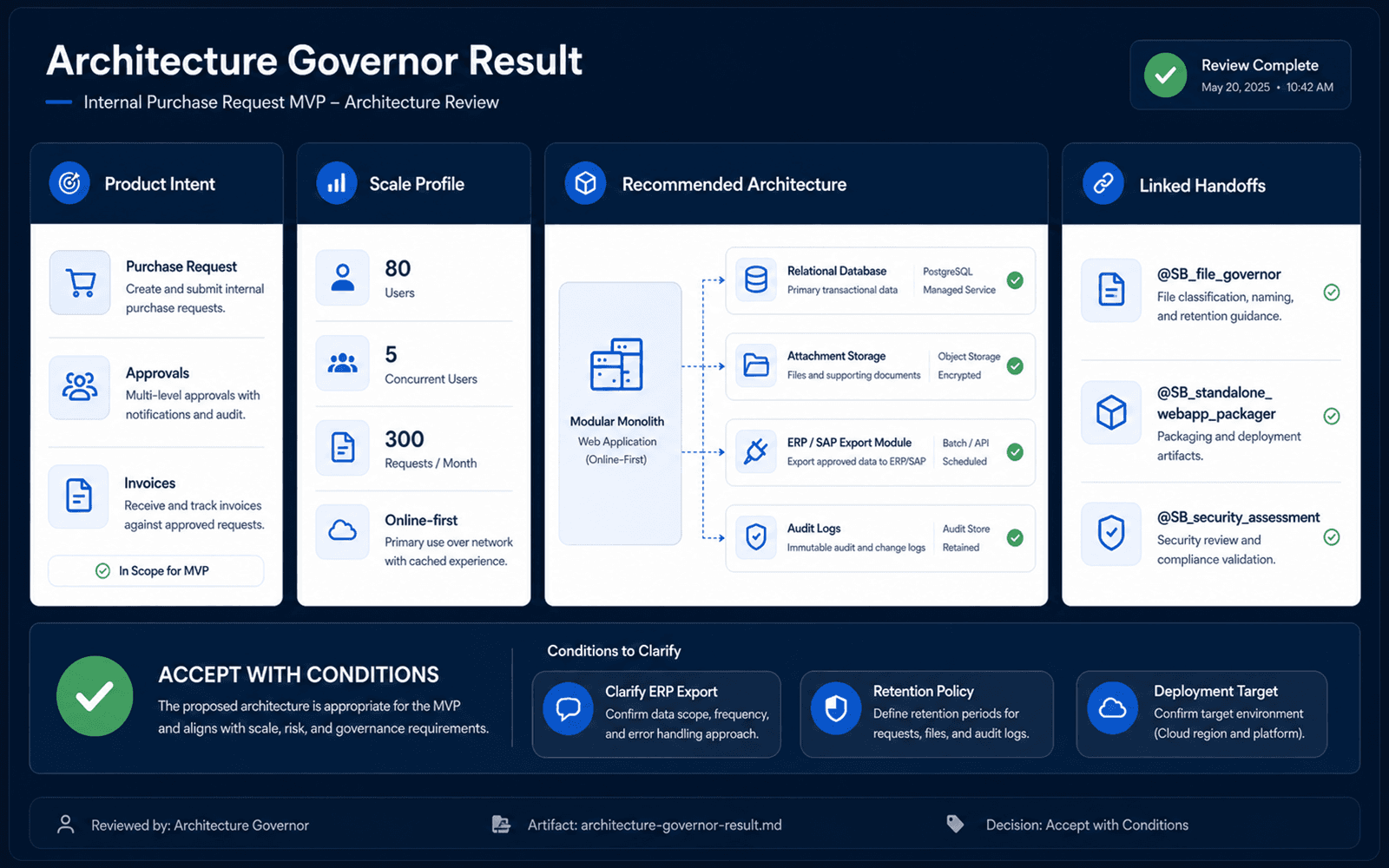
A product can become hard to change not because the first feature was wrong, but because every later feature was attached wherever it seemed convenient. Architecture Governor reads accepted requirements and turns them into system boundaries: module responsibilities, data and API seams, integration points, deployment assumptions, quality attributes, tradeoffs, and downstream handoffs. It helps the buyer avoid a codebase that accidentally grows around weak structure.
When this helps
What you get
- Architecture decision notes
- Module boundaries
- Tradeoff record
- Governor handoffs
Use it when
- Your product is no longer a simple page and now has workflows, data, APIs, payments, admin areas, reports, or multiple user roles.
- The app still works, but you are worried that every new feature is being attached to the wrong place.
- You need clear system boundaries before AI keeps building on top of a fragile structure.
Not the right fit when
- It is not necessary for tiny throwaway pages. It is valuable when the app has workflows, data, integrations, or future growth risk.
What this prepares next
Clearer system shape -> Fewer late rebuilds -> Better implementation discipline
Why this is stronger than asking AI once
A one-time architecture suggestion can choose a pattern but fail to record why the system should be shaped that way. Architecture Governor is stronger because it captures decisions, module boundaries, assumptions, tradeoffs, and downstream handoffs before code spreads across the repo. The buyer gets a system shape that later sessions can follow instead of redesigning from memory. Boundary: It is not necessary for tiny throwaway pages; it is valuable when the app has workflows, data, integrations, or growth risk.
Included interface patterns
Scale-Aware Architecture Intake
Questions product stage, users, document/transaction volume, devices, connectivity, security, and deployment before decisions.
Scale and risk profile with facts, assumptions, and unknowns.Architecture Decision Package
Maps components, data, integrations, deployment, offline behavior, and tradeoffs to requirements and constraints.
Decision table, rejected alternatives, risks, and accept/clarify/reject status.Linked Skill Handoffs
Prepares file registration, standalone packaging configuration, and security assessment scope.
@SB_file_governor, @SB_standalone_webapp_packager, and @SB_security_assessment handoff blocks.