
File ownership mapped is handled by this skill in a customer-readable, reusable workflow.
Cleanup made reversible is handled by this skill in a customer-readable, reusable workflow.
SB_file_governor@SB_file_governorFree | File ControlIncluded in bundle10 minutes
What is this?
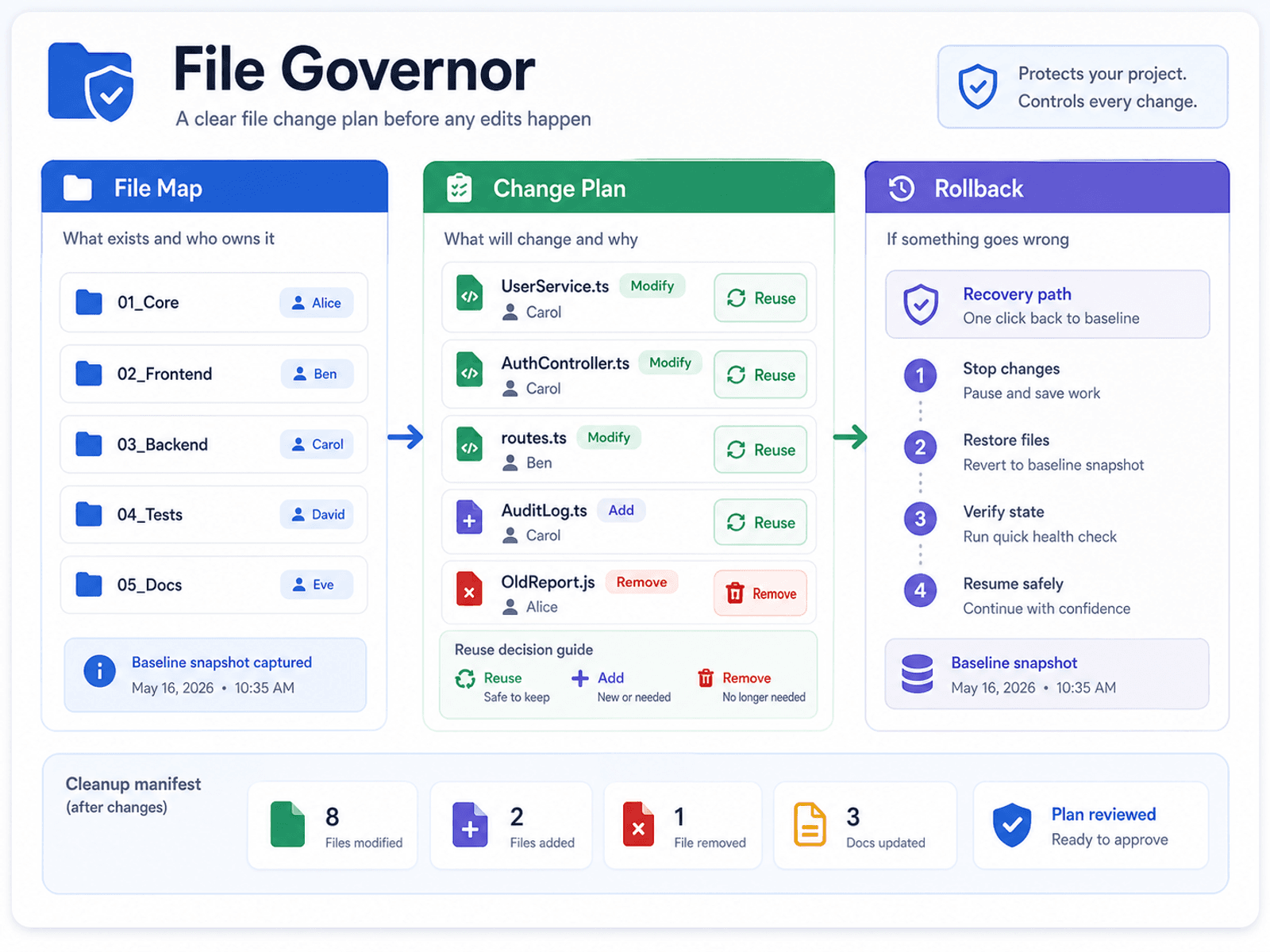
AI-built projects become risky when active code, generated files, old drafts, examples, and backups all look equally important. File Governor makes the agent slow down before touching the file system: identify the file purpose, check whether something reusable already exists, decide ownership, update the registry, and keep a recovery path. It solves the practical pain of "which file is real, and can this be changed safely?" before clutter turns into broken work.
When this helps
What you get
- File change plan
- Registry update
- Cleanup manifest
- Rollback notes
Use it when
- Your project has too many AI-created files and you are no longer sure which ones are real, old, draft, generated, or actively used by the app.
- You want AI to clean or reorganize files, but you are afraid it may delete, overwrite, or duplicate the wrong thing.
- The project needs a clearer file map so the next AI session does not continue from the wrong source.
Not the right fit when
- It does not decide product strategy. It controls file risk and traceability around approved work.
What this prepares next
Safer file edits -> Less duplication -> Clearer ownership
Why this is stronger than asking AI once
Telling AI to add or clean files can quickly create duplicate modules, mystery helpers, and deleted context that the next session cannot explain. File Governor is stronger because it makes the agent check file purpose, reuse options, input/output contracts, registry ownership, and rollback before file changes become permanent debt. The buyer gets safer edits and a clearer map of why each file exists. Boundary: It does not decide product strategy; it controls file risk and traceability around approved work.
Included interface patterns
File Change Plan
A focused plan before adding, editing, moving, renaming, splitting, or deleting files.
Path, action, purpose, owner task, risk, registry delta, and verification.Registry Entry
A reusable record that explains why a file exists and when an agent should use it.
Purpose, trigger, category, inputs, outputs, dependencies, and verification note.Long-File Split Plan
A pre-refactor gate for files over 400 lines when responsibilities need to be extracted.
Responsibilities, proposed boundaries, migration steps, recovery, and @SB_clean_code handoff.Safe Cleanup Manifest
A reversible cleanup table for files that may be moved, consolidated, quarantined, or removed.
Classification, destination, recovery path, reference evidence, and verification.