
Requirement trace is handled by this skill in a customer-readable, reusable workflow.
Scope discipline is handled by this skill in a customer-readable, reusable workflow.
SB_srs_executor@SB_srs_executorAgent SetupIncluded in bundle10 minutes
What is this?
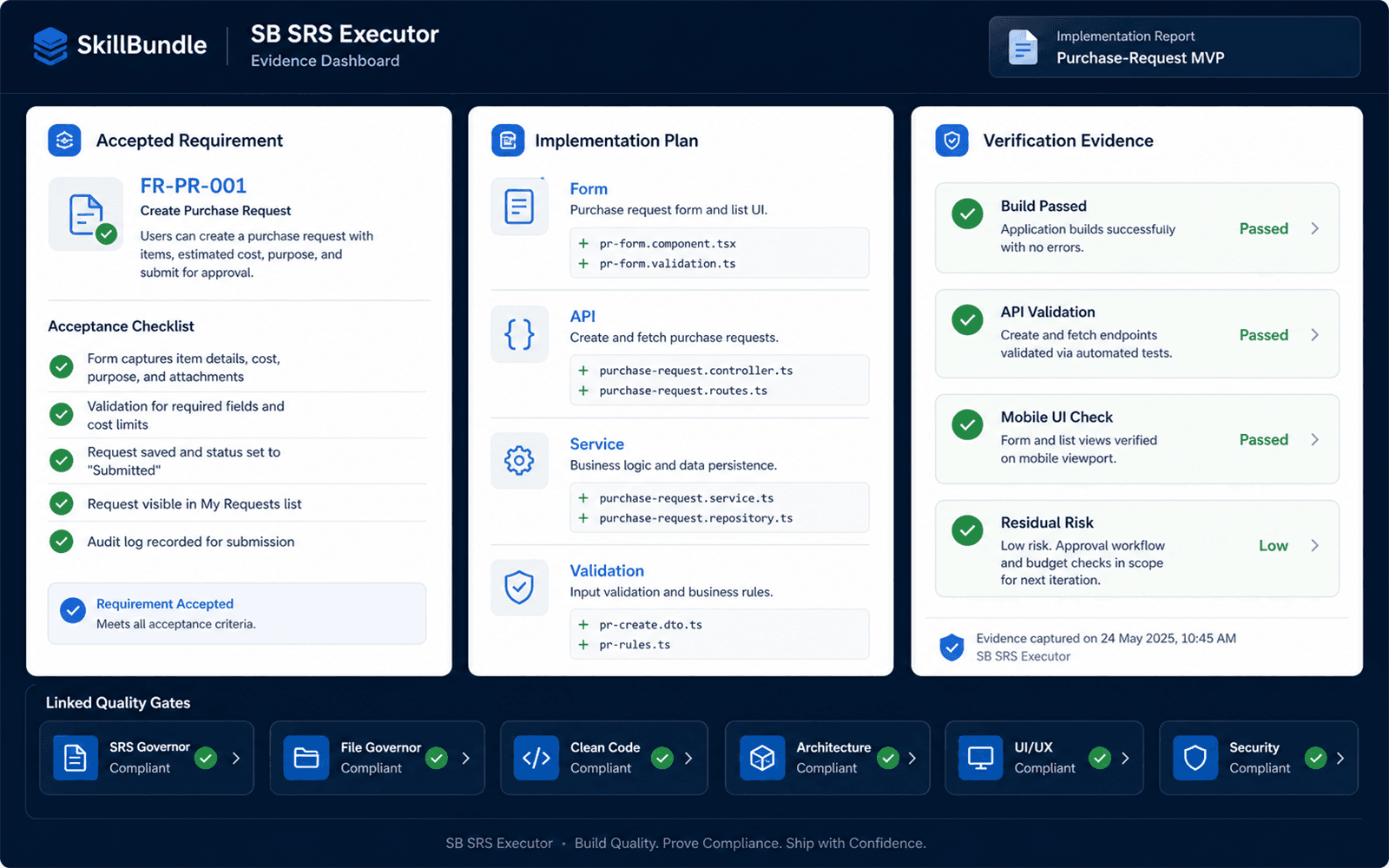
Even accepted requirements can fail during coding when the agent follows the newest chat instruction instead of the build contract. SRS Executor implements from an approved Software Requirements Specification (SRS): the document that defines what the software must do. It locks work to requirement IDs, acceptance criteria, scoped tasks, linked specialist handoffs, and verification evidence, so the owner can see what changed, which requirement it served, and what risk remains.
When this helps
What you get
- Requirement-to-task plan
- Implementation notes
- Evidence log
- Residual risk report
Use it when
- Requirements are already approved and you need AI to build from them instead of drifting with the latest chat instruction.
- Working code is not enough, because you still need to know which requirement each change satisfies.
- You want implementation tasks, evidence, and remaining risks tied back to the accepted product scope.
Not the right fit when
- Requirements are still unstable. First stabilize the SRS with the creator/governor path.
What this prepares next
Less build drift -> Clearer requirement coverage -> Better release evidence
Why this is stronger than asking AI once
Telling AI to build a feature can follow the latest chat instruction and drift away from the accepted requirements. SRS Executor is stronger because it turns approved Software Requirements Specification (SRS) items into scoped implementation tasks, file changes, and evidence logs. The buyer gets build work that can be checked against requirement IDs instead of judged from memory. Boundary: It should not be used when requirements are still unstable; first stabilize the SRS with the creator/governor path.
Included interface patterns
Requirement Lock
Confirms accepted Requirement IDs, SRS sources, acceptance criteria, scope, and verification before implementation.
Requirement lock and scoped SRS reading log.Traceable Implementation Plan
Maps each acceptance criterion to planned files, linked skill gates, and verification evidence.
Requirement-to-task table and linked governor handoff blocks.Verified Code Handoff
Reports files changed, Requirement IDs, tests, manual checks, task evidence, and residual risks.
SRS Executor Result ready for project review.